In Defence of Idiosyncratic Learning Experiences
Designing a Tertiary Ideation Institution that responds to the idiosyncratic learning space needs and preferences of a variety of individual students
Project Type:
Project Name:
Year:
Location:
Further information:
Studio Leader:
Key terms:
Student – MArch(Prof)
Architecture - Educational spaces
Towards Idiosyncrasy in Learning Spaces
2021
Bertrams, Johannesburg
This project was completed in fulfilment of the requirements for the MArch(Prof) degree.
Nico Botes
Learning Spaces, Educational Typology, Idiosyncrasy, Individual Spatial Needs, Alternative Learning Paradigm, [Sub]urban Adaptation, Biophilia
For the full dissertation document, please click here

Project Abstract:
Individuals are inherently different and so are their spatial needs related to learning. Unfortunately the current dominant learning space typology disregards this, opting for ‘one size fits all’ learning spaces that actually don’t fit anyone while still expecting all students to perform to the best of their abilities.
This project thus investigates alternatives to the current dominant learning space typology in order to identify and develop an alternative that is more appropriate for the times in which we live as well as the diverse variety of students that are being accommodated in contemporary tertiary learning institutions. This is especially pertinent in 2021, since COVID-19 has caused educational spaces to be reconsidered in ways and to an extent that is unprecedented in recent decades, giving alternative approaches a valuable opportunity to enter into the general discussion.
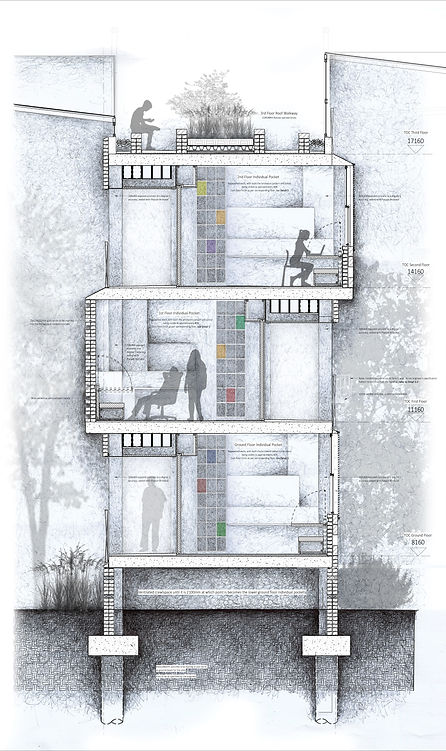
Subsequently this project proposes a tertiary learning institution that enables idiosyncratic learning experiences by placing specific emphasis on creating spaces that celebrate individualism and equity by enabling students to learn in spaces that cater to their individual spatial needs and preferences.
Because every student deserves to learn in a space that complements and promotes their ideal learning experience.
THE PROBLEM:
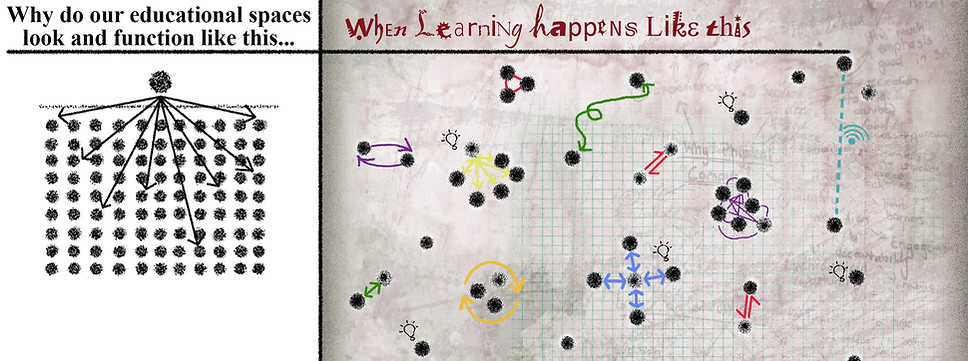
Over the last 150 years how we learn, what we learn and even why we learn has changed.
Yet the spaces where we are expected to learn has remained largely unchanged...


History of learning space typologies:

Problematic consequences of learning spaces not changing:


INVESTIGATIONS:

Precedent studies:
Precedent studies formed an integral part in identifying and understanding what alternatives already exist. Their greatest value, however, lay in displaying and contextualising how spaces and learning models influence and inform each other.
Fieldwork:
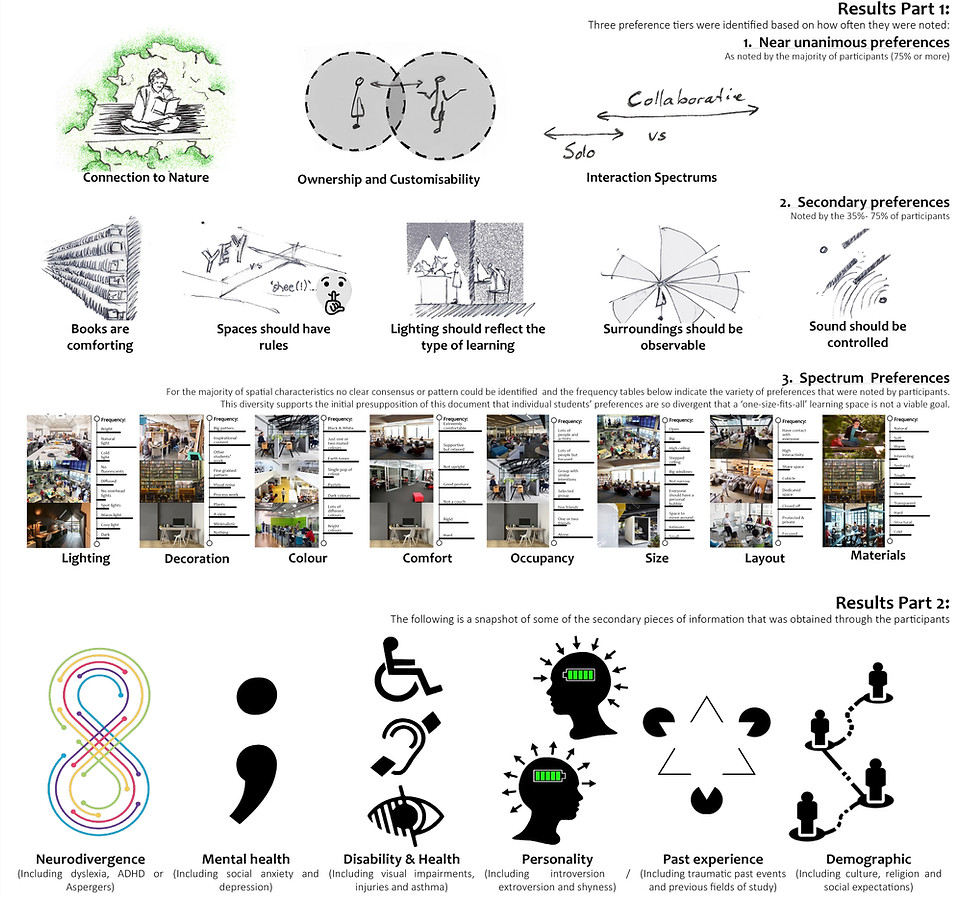
In addition to the precedents above, extensive interviews and surveys were conducted in order to understand the needs of students, specifically in the context of Johannesburg South Africa.
From these interactions, many valuable insights were gained and these directly lead to the three primary principles that were proposed in this project:
- Connections with nature
- Ownership & customisability
- Interaction spectrums