

Perceived Mountain Experience
Student Project (Honours)
Project Type:
Project Name:
Year:
Location:
Further information:
Studio Leader
Key terms:
Student – BArch(Hons)
Architecture & Landscape - an experiential walkway
Perceived Mountain Experience
2020 – Quarter 1 design project
Mothong Heritage Site, located on the Magliesburg Mountain range north of Mamelodi
-
Project includes a notable group mapping exercise, a review of appropriate flora and public participation. See here for more information
-
The project’s brief stipulated that this design was to be situated within the masterplan developed for the site in S. Tuke’s March(Prof) project completed in 2018.
Ida Breedt
Genius loci, place identity, Gestalt Psychology, perception, ecological design, experiential design, Mamelodi
Project Summary:
This project was designed with the intention to enable visitors to fully engage with the spatial spirit of the Mothong Heritage Site by heightening their sensory perception before they enter the site itself. This was done through an experiential walkway that makes strategic use of the way our brains process stimuli in order to make visitors progressively more aware of their environment, specifically the natural environment in this case.
Biodiversity mapping of the Future Africa Campus can be found here


This problem statement lead me to question what an experience actually is and how it can be changed.
In a nutshell, an experience is the process by which external stimuli is absorbed before being combined with our own preconceptions and resulting in a perception, with many perceptions together being considered an experience.
Where the problem comes in is that at any given moment we are receiving approximately 11 million bits of information per second, and unfortunately our brain can only process approximately 50 of those incoming bits. Thus, in order to maximise the impact of the 50 bits, our brains take shortcuts (better known as sensory heuristics) and filters the stimuli you receive to make extensive assumptions about everything it cannot individually process. It does this by making use of past experiences, preconceptions and our pre-existing body of knowledge, in order to make educated guesses about what is going on around you, i.e. constructed experiences.
What one actually wants, however if for people to have perceived experiences, which is when they actively engage with and experience their surroundings.
This is usually a result of ambiguous stimuli and Multi-Stable environments, which occur when one's brain is kept in suspense or is not given sufficient information for it to come to a constructed conclusion. This approach has been extensively used in educational environments as it is theorised that as long as your brain is ‘left in suspense’ it will continue to store information for later use and that the memories attached to this information will also be richer, more vivid and more accurate.

But how can this be used to enhance a visitor’s experience of Mothong?

In order for the value and atmosphere of Mothong to be accessible, it needed to be introduced in a way that would ease the visitor into a mindset that was susceptible for perceived experiences, thus I proposed a walkway that was to act as introduction to the rest of the site.
The first step was to investigate what physical, quantifiable features notably contribute to this qualitative atmosphere and subsequently the southern edge of the lawn terrace and retaining wall (introduced in S. Tuke's masterplan) was selected due to its proximity to the entrance as well as the array of interesting features already located there. This also offered the chance to limit impact on the land as a result of construction or the subsequent use of the walkway, which was advantageous as there are various levels of ecological sensitivity on the site


Before combating Gestalt psychology and the resulting constructed experiences, however, one needs to accept that our brains need their shortcuts, thus multi-stable theory hypothesises that we can use those shortcuts to manipulate what is perceived by making sure that what you want perceived is the most natural thing for someone's brain to perceive.
In spatial terms, I interpreted this to mean that built element considered collectively can elevate some bits of information (experiences) while muting or toning down others.
In the proposal this manifests itself in a progression of moments stitched together through the walkway. Specifically meaning that at the beginning of the walkway one sense is stimulated or one type of stimuli is accentuated at a time and all others are muted. As a visitor progresses the number of stimuli increase and these stimuli start to be put into combinations. The visitor's brain will still only be processing 50 bit of information but it will be filling in the blanks using the (contextually relevant) information just received during the former parts of the walkway.
The combinations of stimuli will continue to grow in complexity, with the visitor's capacity to actually perceive them growing with it, until the visitor finds himself at the end of the walkway which terminates in the natural landscape. At this point the visitor is mentally attuned and more able to fully engage with the true atmosphere of the site.

A similar trend is found with both the organisation of spaces and the spatiality itself. For example, at the beginning the enclosure would be straight and one would not have the impression of having many navigational options, but as one progresses this would relax until at the end one would be free to explore at will.
Similarly, during the initial stages of the walkway light is acutely controlled with only single beams of light, but by the end one would moving through dappled light caused by the timber lattices as if one was under a tree canopy.
Throughout the walkway, visual and physical continuity or lack thereof is used to reinforce the progression of the visitor’s mindset while allowing them to still position themselves in the bigger context on site. Specifically, this can be seen in the fact that during the initial stages of the walkway, the physical path and enclosure is elevated far above the ground, reinforcing the fact that the visitor is not yet ready to engage with the site. This also protects the site from having to accommodate the foundations required by rammed earth walls.
Similarly, by the time you get to the latter part of the walkway, you are effectively in the landscape though you still have a transparent enclosure. This light frame enclosure also limits contact and disruption to the site and it also wouldn’t stop any natural processes, such as runoff or the movement of small animals, from occurring.
The result of overlaying all these spatial tools and their progressions is a walkway that snakes around the site, first along the edge of the artificial terrace before going amongst the vegetation.
The entire walkway is geared towards emphasizing only one thing at the beginning and emphasizing everything by the end, and all the spatial tools support this.
The most apparent of these, is the materials used. When visitors enter the walkway they would find themselves in a rammed earth enclosure, where the surfaces around are natural but consistent, with only a fine texture. For the first few meters one would take interest in this construction method, but after that it will become background information, allowing one's brain to focus on the single aperture and single source of stimulation in an otherwise stereotomic enclosure. As the visitor progresses through the walkway, however, the rammed earth surfaces become more varied and apertures grow larger. About halfway through the walkway, the roof starts to disintegrate into timber lattice-work which in turn will continue to become more organic and less dense as one progresses until one is not contained by anything at all anymore.


The primary function of the walkway is to act as psychological threshold into the site, but it also offers an opportunity to introduce a number of secondary functions that can contribute to the usefulness of the site and the accessibility or depth of place identity perceived by the visitors


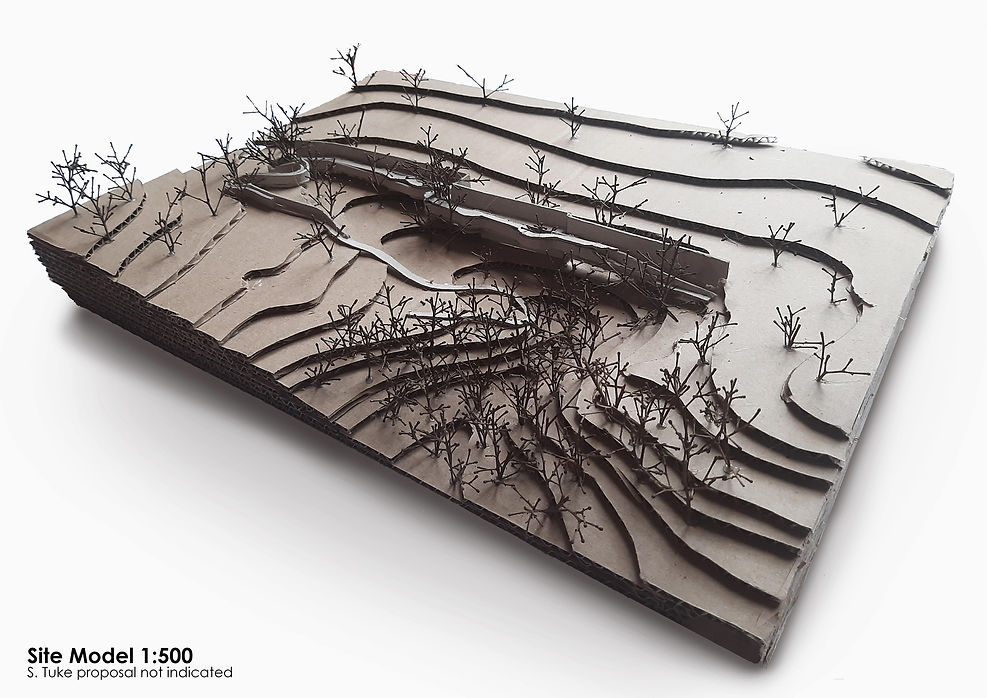
In conclusion, it is only natural for our brains to want to take shortcuts, we live in times when we are bombarded with massive amounts of stimuli every moment of the day and we have evolved to deal with this. But that does not mean we should accept sub-par experiences that have less meaning and depth than we are capable of having, especially when dealing with spaces that are as remarkable as Mothong.
Thus I propose this experiential walkway, with the hope that through it people can be empowered to have deep, meaningful and enriching perceived experiences of Mothong and that by extension this special segment of the landscape can flourish and continue to develop its unique place identity


Group Mapping and fieldwork:
Group work included three sections:
1. Site Assessment and Stakeholder Engagement: analyses and mapping of the existing geological, topographical and vegetation characteristics of the area, along with amenities, activities, history and cultural background


2. Fieldwork Perception Documentation: the perception of people in the built environment of their symbolic landscape and the role of biodiversity and native species will be documented by means of surveys and photo eliciting that will be provided

3. Fieldwork Plant documentation: each student documented five species as found in the biodiversity gardens at Future Africa and the Javett Art Center, that have a climate corresponding to that of the site. Both desktop and physical information about the species were gathered and the plants were monitored and studied for a five week period. The findings were collated into a booklet that has been summarised below:

